Resolved numerical simulations
Verified interface, wetting, transport, and conservation methods for unstructured finite-volume calculations.
Agentic computational science · verified engineering
I help industrial R&D teams improve heat-transfer and multiphase-flow systems—with quantified uncertainty. Agentic workflows accelerate CFD model development, testing, and optimization; verification, provenance, and human review show which improvements can be trusted.
Primary design service
Agentic workflows coordinate model development, solver execution, verification, evidence extraction, and auditable design records. Bayesian optimization directs expensive evaluations. Open-source CFD resolves the governing physics. Feasibility, convergence, conservation, provenance, and engineering judgment remain visible in every accepted result.
Connected capabilities
Each layer strengthens the next: resolved physics generates meaningful data; probabilistic models expose uncertainty; optimization converts both into action.
Verified interface, wetting, transport, and conservation methods for unstructured finite-volume calculations.
Microfluidic filling, viscoelastic interfaces, surfactants, mass transfer, and capillary flows in consequential geometries.
High-speed imaging, automated measurements, and process data that reveal missing physics and operating variation.
Uncertainty-aware surrogates and gated optimization when simulations and experiments are expensive.
Selected results
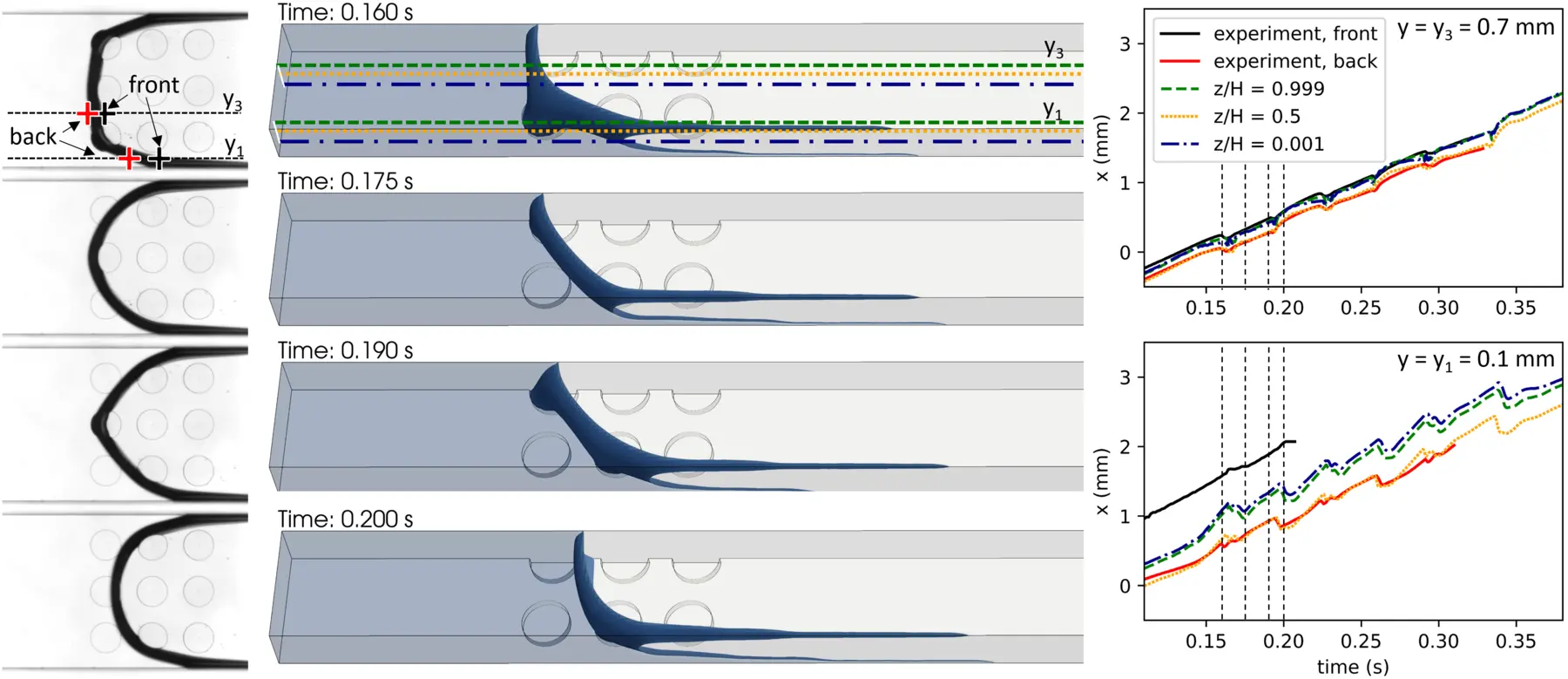
High-speed experiments, automated image analysis, and resolved geometric-VOF simulations establish the foundations for industrial microfluidic digital twins.
Explore the four-study programPeer-reviewed LENT and geometric-VOF formulations remain stable where small discrete inconsistencies can otherwise dominate the result.
Explore the numerical evidenceSelected publications
The complete record spans multiphase methods, microfluidic experiments, scalable CFD + ML, and research infrastructure—with direct links to the supporting research outputs wherever they are publicly available.
A deterministic residual-based non-orthogonality correction restores surface-tension and gravity force balance near linear-solver tolerance on polyhedral meshes.
A scalable, in-memory coupling enables online training and inference between parallel OpenFOAM simulations and machine-learning models.
High-speed experiments and three-dimensional geometric-VOF simulations identify distinct microcavity-filling regimes and the conditions controlling gas entrapment.
Teaching
Courses and open materials connect mathematical foundations with reproducible engineering practice—from Mathematics II to Machine Learning in Fluid Mechanics and OpenFOAM–ML hackathons.
Teaching & supervision →Computational practice
OpenFOAM Data-Driven Modelling, LEIA/LENT, DeboRheo, SFB 1194, NFDI4Ing, and current agentic workflows connect methods, people, and reusable evidence. Agents help develop, test, document, and audit; verification and human judgment decide what is accepted.
Explore the workflow →A hard thermofluid problem?